Three-family Broad-Latin deterministic italicification benchmark
Purpose
This clean-room benchmark evaluates the experimental Glyphs MCP italic first-pass workflow in Inter, Noto Sans, and IBM Plex Sans. It compares three deterministic candidates generated from the same Roman outlines:
- Raw is a pure shear.
- Partial compensation is the legacy
cursivyresult key in this headless benchmark. It applies the repository's pure-Python stem correction at strength0.35; it does not invoke the Glyphs Cursivy filter. - Balanced uses curve interpolation strength
0.75followed by the same deterministic correction engine at full strength.
The generated outlines are design-assistance evidence, not finished italics. The official italics are qualitative references containing deliberate drawing, rhythm, spacing, component, and character-form decisions that a mechanical first pass should not attempt to reproduce automatically.
Fixed coverage
The committed manifest fixes 543 Unicode values and the Inter/Noto Sans source glyph names. IBM Plex Sans is resolved by Unicode from its pinned Regular and Italic UFOs; 391 of the 543 values are present in both. The JSON evidence records all 152 unavailable Plex entries rather than silently dropping them.
| Group | Fixed manifest | Inter | Noto Sans | IBM Plex Sans |
|---|---|---|---|---|
| Basic Latin | 95 | 95 | 95 | 95 |
| Latin-1 | 91 | 91 | 91 | 91 |
Latin Extended through U+024F | 259 | 259 | 259 | 158 |
| General Punctuation | 48 | 48 | 48 | 16 |
| Currency Symbols | 23 | 23 | 23 | 14 |
| Letterlike Symbols | 10 | 10 | 10 | 3 |
Number Forms through U+218F | 17 | 17 | 17 | 14 |
| Benchmarked total | 543 | 543 | 543 | 391 |
Two historical Inter/Noto Sans source-name differences are mapped by Unicode:
Tcommaaccent/Tcedilla at U+0162 and Iota/Iota-latin at U+0196.
Result: deterministic Balanced promoted
Balanced is the deterministic geometry winner in every family. It restores
the measured source width of accepted conservative stem pairs and has the
lowest equal-family mean error. It passes every safety gate and is promoted as
the recommended experimental mode. The omitted slant_mode default remains
Cursivy for backward compatibility.
| Family | Topology | Source unchanged | Compensated pairs | Raw error | Partial error | Balanced error | Anchor error |
|---|---|---|---|---|---|---|---|
| Inter v4.1 | 543/543 | 543/543 | 135 | 2.7812 | 1.8078 | <0.00000000000004 | 0 |
| Noto Sans | 543/543 | 543/543 | 102 | 1.2912 | 0.8393 | <0.00000000000002 | 0 |
| IBM Plex Sans | 391/391 | 391/391 | 102 | 1.2607 | 0.8194 | <0.00000000000002 | 0 |
| Equal-family mean | — | — | 339 | 1.7777 | 1.1555 | <0.00000000000002 | — |
Balanced reduced mean source-width error by more than 99.99% versus both alternatives in each family. This near-zero result applies only to confidently accepted straight-side pairs. It does not measure optical completion or similarity to a deliberately drawn italic.
The review also found component transforms for which slanting a component
locally and then applying its component matrix (L × S) differs from shearing
the complete Roman construction (S × L). Deterministic Balanced now blocks
those glyphs before generation:
| Family | Affected glyphs | Reflected cases | Other non-commuting cases | Blocked | Unsafe applications | Safety gate |
|---|---|---|---|---|---|---|
| Inter v4.1 | 23 | 17 | 6 vertically scaled marks | 23 | 0 | Pass |
| Noto Sans | 2 | 2 | 0 | 2 | 0 | Pass |
| IBM Plex Sans | 0 | 0 | 0 | 0 | 0 | Pass |
This explains the earlier d/q observation. Inter constructs d from a
horizontally reflected b and q from a reflected p; local slant followed
by reflection reverses their apparent direction. IBM Plex Sans draws d,
p, and q directly, so those glyphs lean in the expected direction. The
problem is construction-dependent, not a negative angle being supplied to
selected glyphs.
The affected Inter rows are d, q, dcaron, dcroat,
Ohungarumlaut, ohungarumlaut, Uhungarumlaut, uhungarumlaut,
dtopbar, Tonetwo, dzcaron, Udieresismacron,
udieresismacron, Adieresismacron, adieresismacron, Adotmacron,
adotmacron, dz, dcurl, quotereversed, paragraphreversed,
reversedsemicolon, and dong. Noto Sans is affected at
paragraphreversed and reversedsemicolon.
This construction issue can also affect any method that slants component
sources before applying a non-commuting transform. Balanced does not silently
omit the glyphs: the reviewed batch is blocked, and the designer may explicitly
rerun with skip_glyphs after deciding how to rebuild or draw those forms.
Raster review and mode separation
The 543 Inter glyphs, 543 Noto Sans glyphs, and 391 Plex glyphs were rendered
at 2× scale in pages of at most 64 glyphs. The full paginated evidence and
per-glyph JSON remain in the ignored
.cache/italic-benchmark/results-broad-deterministic directory.
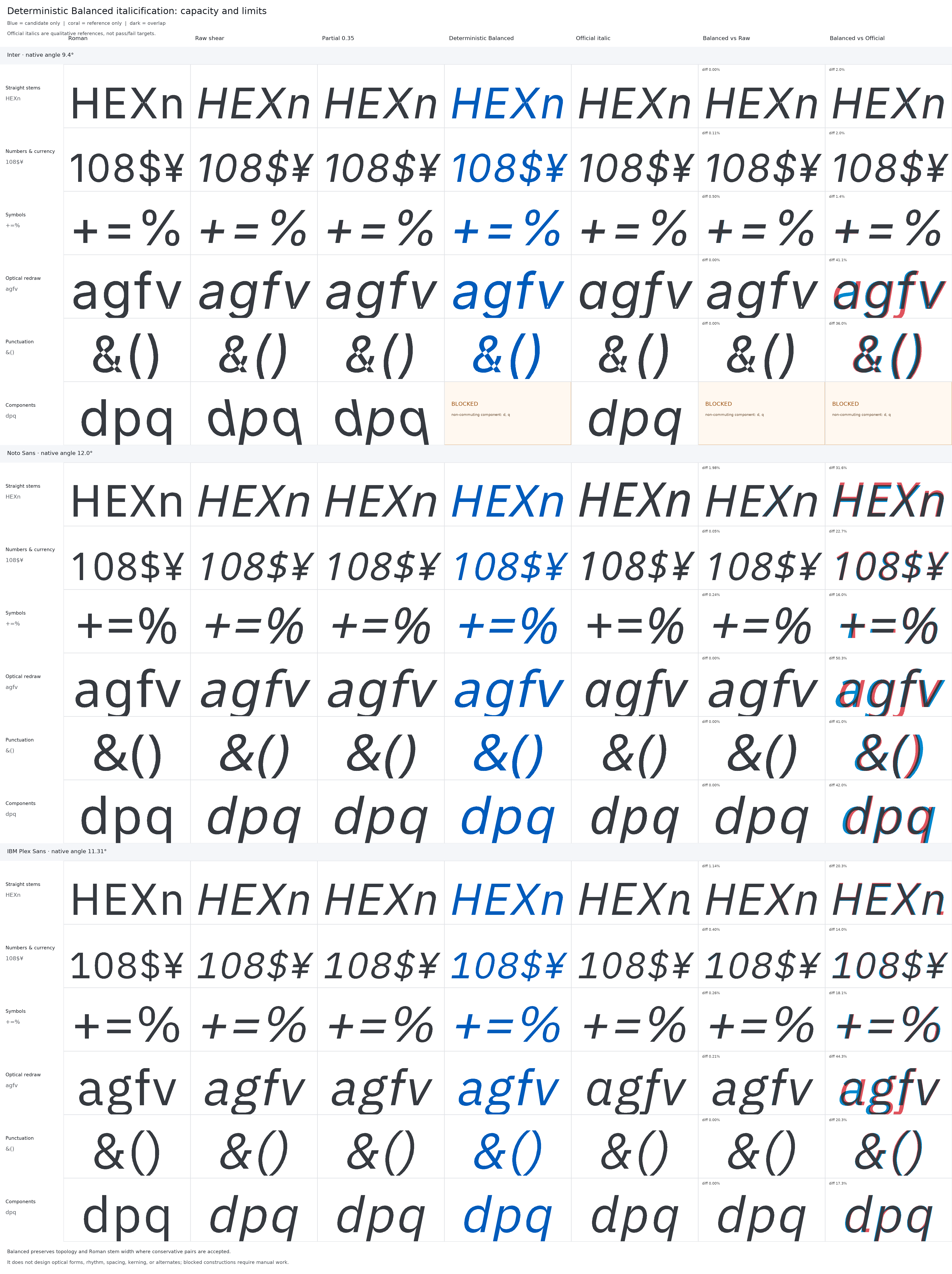
The combined 144-DPI story sheet is a deterministic 4800 × 6424 PNG. It
shows capacity examples, forms that need deliberate italic redrawing, blocked
component constructions, Balanced-versus-Raw overlays, and
Balanced-versus-official overlays with magnified insets. Click it for the
full-resolution image.
The committed 144-DPI audit sheets prioritize component-direction risks,
accepted-pair glyphs, representative categories, and the largest qualitative
official-italic differences. Click an image for the full
4300 × 23800 contact sheet or 4380 × 23844 difference sheet.
Inter v4.1


Noto Sans


IBM Plex Sans


Dark pixels overlap, blue pixels occur only in the candidate, and coral pixels occur only in the reference. Thin blue and coral lines show the respective advance widths.
| Family | Partial vs Raw | Balanced vs Raw | Balanced vs Partial | Balanced vs official |
|---|---|---|---|---|
| Inter v4.1 | 0.123% (64/543) | 0.269% (86/543) | 0.151% (59/543) | 7.237% |
| Noto Sans | 0.121% (46/543) | 0.205% (51/543) | 0.088% (40/543) | 29.219% |
| IBM Plex Sans | 0.106% (27/391) | 0.213% (50/391) | 0.114% (36/391) | 19.798% |
Values are mean silhouette differences; parentheses give the count of glyphs
with at least one different raster pixel. The median generated-mode difference
is zero in all families because the conservative correction engine changes
only accepted stem pairs. This is why Raw, partial compensation, and Balanced
look identical for most glyphs, including many curved forms. With
stem_compensation=1.0, the final correction restores accepted stems to their
Roman perpendicular width, so it can also neutralize part of the visible
intermediate difference controlled by curve_strength.
The deterministic Partial column is the pure-Python correction engine at
strength 0.35. It is not the live Glyphs Cursivy filter. Real Cursivy remains
host-specific and can vary with the installed Glyphs and Transformations filter
version.
Official-italic differences remain qualitative and are not an optimization target. They show where a designer deliberately redrew forms beyond a mechanical emphasis companion.
Reproduction
Keep the pinned source checkouts beneath the ignored
.cache/italic-benchmark directory, then run:
python3.12 scripts/benchmark_italic_sans_broad.py \
  --render-scale 2 \
  --page-size 64 \
  --audit-limit 64
The script exits zero when every family passes. Its JSON records coverage, topology, source immutability, anchors, components and transform risks, blocked constructions, bounds, advance widths, detected and skipped stem pairs, width measurements, all four raster comparisons, failures, and runtime.
Sources are pinned at:
- Inter
e3a3d4c57d5ecc01453a575621882a384c1995a3 - Noto Sans
cb097900c74b26e6dcab899b4f07b2bc79dd80c4 - IBM Plex Sans source mirror
71d012bccb31a2e282cc46de63b387ff7f676287
IBM Plex's upstream project and all three pinned benchmark sources use the SIL Open Font License 1.1. No font source or binary is committed.
Clean-room provenance
The benchmark exercises the repository's original interpolation and straight-stem correction engine. It does not call, inspect, decompile, or copy Italify or another proprietary implementation. The same conservative detector, correction limits, and promotion rules apply without family-specific optical tuning.